



You know you're capable of more.
More focus. More clarity. More drive.
Most people feel the gap. They just misread what's causing it.
Brain fog. Low motivation. The inability to push through the afternoon or hold a clear train of thought. These are signals. Not character flaws. They're the brain communicating that something in the inputs is off.
Brain Awareness Month exists to shift that conversation away from resignation and toward something actionable. The gap between what you're capable of and how you're currently performing is often nutritional, and that means it's addressable.
The Signal Most People Misread
The brain is the most metabolically demanding organ in the body. It consumes roughly 20% of your total energy while making up just 2% of your body weight. Sustaining focus, memory, decision-making, and drive at the level modern life requires is an enormous biochemical task. It requires a precise, continuous supply of specific nutrients.
When those inputs fall short, the brain doesn’t simply slow down uniformly. It starts triaging. The functions that feel most optional, sustained motivation, sharp recall, the patience for complex thinking, are often the first to degrade.
Most people don’t experience this as a nutritional problem. They experience it as a them problem. A lack of willpower. A character deficit. Something to push through with more caffeine and fewer complaints.
The brain’s performance ceiling is determined in large part by the inputs you give it. Change the inputs, and you change the ceiling.
What Your Brain Actually Needs
Cognitive performance is the result of specific biochemical processes: neurotransmitter synthesis, cell membrane maintenance, cerebral circulation, and protection against oxidative stress. Each of these processes depends on specific compounds. When those compounds are missing or depleted, performance reflects it.
The nutrients that move the needle most fall into a few key categories:
Choline and phospholipids: Citicoline is one of the most researched cognitive ingredients available. It acts as a precursor to phosphatidylcholine, a compound essential for maintaining healthy brain cell membranes and supporting the synthesis of acetylcholine (the neurotransmitter most directly linked to focus and mental clarity). Alpha-GPC, another highly bioavailable choline compound, has been shown to support memory formation and cognitive performance, particularly under conditions of mental demand or fatigue.
Cerebral circulation: Ginkgo Biloba Extract supports blood flow to the brain, which affects how efficiently neural resources are delivered and how quickly the brain can retrieve information. Better circulation translates directly to sharper recall and more sustained attention.
Neurotransmitter precursors: N-Acetyl-L-Tyrosine is a bioavailable form of tyrosine; the amino acid the brain uses to synthesize dopamine and norepinephrine. These are the neurotransmitters behind motivation, focus, and the capacity to perform under stress. Chronic stress and poor sleep burn through them faster than the body can replenish at baseline. When they’re depleted, the experience is unmistakable: effort feels harder; concentration is harder to hold, and the drive to engage simply isn’t there.
These are the biochemical inputs your brain is already trying to use. The question is whether they’re actually available in sufficient supply.
Why Nutrition Gets Overlooked
Modern life is exceptionally good at depleting the nutrients the brain relies on. Chronic stress burns through dopamine precursors and disrupts neurotransmitter balance. Poor sleep impairs the brain’s ability to consolidate memory and clear metabolic waste. Nonstop stimulation from screens and notifications keeps the brain in a low-grade reactive state that is cognitively expensive and nutritionally costly.
Most people address this with caffeine, willpower, or the vague intention to sleep better. What they rarely address is the nutritional layer, the specific compounds the brain needs to function well that modern diets consistently underdeliver.
The brain doesn’t synthesize choline in adequate amounts on its own. It doesn’t produce tyrosine under stress. It can’t manufacture the phospholipids that keep neural membranes healthy without the right dietary inputs. And when those inputs are missing, lifestyle interventions alone can’t fully compensate.
This is why the performance gap so often persists despite genuine effort. The effort is real. But the raw materials aren’t there to support it.
Closing the Gap
The good news is that the brain responds. Provide the right inputs consistently, and the changes are measurable in focus, in the ease of sustained attention, in the quality of motivation rather than just its presence.
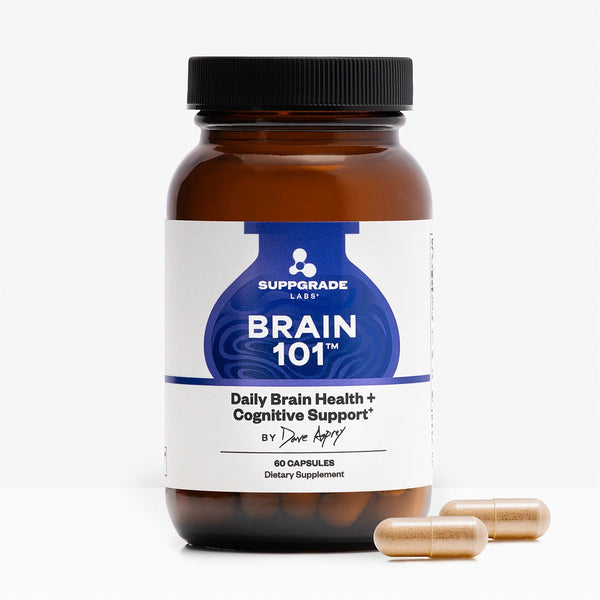
This is what Brain 101 from Suppgrade Labs was formulated to do. Citicoline, Alpha-GPC, and Ginkgo Biloba Extract work together to support the focus, memory, and long-term brain health that your cognitive demands require. As targeted nutritional support for a brain that is already doing its best with what it’s been given.
The gap between where you are and what you’re capable of is real, and it’s nutritional. And that means it’s addressable.
Brain Awareness Month is a useful reminder. But the biology doesn’t pause between now and next year. The inputs that support cognitive performance matter every day, and the sooner they’re in place, the sooner the gap starts to close.
Give your mind what it actually needs.
Explore Brain 101 by Suppgrade Labs formulated for focus, memory, and long-term cognitive health.
Frequently Asked Questions
What causes brain fog?
Brain fog is commonly caused by depletion of the neurotransmitters and nutrients the brain relies on for sustained cognitive function, particularly acetylcholine, dopamine, and norepinephrine. Chronic stress, poor sleep, and nutritional gaps all accelerate this depletion. The experience of brain fog, sluggish thinking, difficulty concentrating, low mental energy, is often the brain’s signal that the inputs supporting cognitive performance are running low.
What are the best supplements for focus and memory?
The most well-researched ingredients for focus and memory include Citicoline (supports acetylcholine synthesis and cell membrane health), Alpha-GPC (enhances memory and cognitive performance under demand), and Ginkgo Biloba Extract (supports cerebral blood flow and recall speed). Brain 101 by Suppgrade Labs combines all three in a single daily formula designed to address the core nutritional drivers of cognitive performance.
How do I improve cognitive function naturally?
Improving cognitive function naturally involves addressing the nutritional, sleep, and stress inputs that determine how well the brain can perform. On the nutritional side, supplementing key compounds (choline precursors, amino acids for neurotransmitter synthesis, and botanicals that support blood flow) provides the brain with resources it cannot produce or obtain in sufficient quantities from diet alone. Consistent sleep and stress management support the brain’s ability to consolidate those inputs.
Why do I have low motivation even when I’m trying hard?
Motivation is a neurochemical state, not just a mindset. The drive to initiate and sustain effort is governed primarily by dopamine and norepinephrine. When these neurotransmitters are depleted through chronic stress, sleep deprivation, or insufficient nutritional support, effort feels harder than it should, regardless of intention. Addressing the underlying nutritional inputs is often more effective than trying to push through with willpower alone.
What is Brain Awareness Month?
Brain Awareness Month (observed in June) is a global public health campaign focused on raising awareness of brain health and neurological wellbeing. It’s an opportunity to examine the inputs, nutritional, lifestyle, and medical, that influence how well the brain functions, and to take proactive steps before problems become apparent.
How do brain health supplements work?
Brain health supplements work by providing compounds the brain uses to produce neurotransmitters, maintain cell membrane integrity, support cerebral circulation, and protect neural tissue from oxidative stress. Unlike stimulants, which temporarily force activity, targeted nutritional support works with the brain’s existing systems, providing the raw materials it needs to perform at its natural capacity rather than overriding its baseline state.