



Cortisol is running your summer. Here is what that actually means.
Summer stress is quieter than you think. And louder than you realize. By the time you feel it, the wired exhaustion at 10pm, the brain that won't stop running through tomorrow's list at 1am, the 2pm spiral that started on a Tuesday and never quite ended, cortisol has been elevated for weeks.
Cortisol is the body's primary stress hormone. A survival mechanism, designed to mobilize energy and sharpen focus in the face of a threat. The human body cannot reliably distinguish between a physical threat and a packed summer schedule. It responds to both the same way: cortisol goes up, the nervous system goes on high alert, and the body stays there.
This is The Summer of No Stress. The goal isn't the absence of stress. It's the biological ability to manage it so it stops running the show.
What summer does to cortisol
- Travel disrupts circadian rhythm, which cortisol regulation depends on
- Heat activates physiological stress responses that elevate cortisol
- Packed social calendars mean the nervous system rarely gets a genuine off signal
- Disrupted routines remove the anchors, consistent sleep, meals, movement, that help regulate the HPA axis
- For high-performers, the expectation to produce does not pause for summer, creating a compounding load
What elevated cortisol does to your body
Cortisol's effects are wide-ranging. When elevated consistently, even at moderate levels, the downstream effects compound:
- Sleep quality suffers: cortisol and melatonin operate on opposing rhythms. Elevated cortisol at night suppresses the natural sleep cycle.
- GABA signaling decreases: GABA is the brain's primary calming neurotransmitter. Chronic stress suppresses it, keeping the brain active when it should be winding down.
- Recovery slows: tissue repair, muscle rebuilding, and immune function all require the parasympathetic state that elevated cortisol works against.
- Focus and mood are affected: cortisol competes with the neurotransmitter systems involved in motivation, attention, and emotional regulation.
- Energy feels flat: the wired-during-the-day, exhausted-but-unable-to-sleep pattern is a cortisol disregulation pattern.
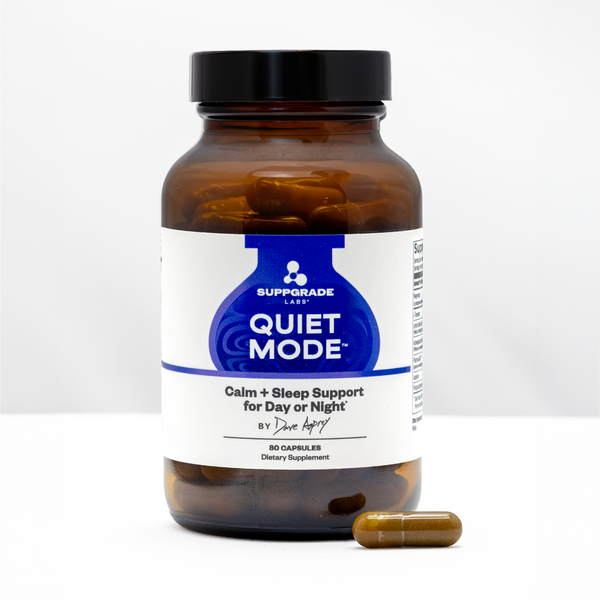
How Quiet Mode™ addresses cortisol directly
Quiet Mode™ works by addressing the cortisol load that keeps the nervous system elevated. When cortisol comes down, sleep follows naturally.
Sensoril Ashwagandha at 125mg, Clinical Dose
Sensoril is one of the most clinically researched branded forms of ashwagandha. As an adaptogen, it supports the body's stress response by helping regulate cortisol production through the HPA axis. At 125mg, Quiet Mode™ delivers this ingredient at a dose with strong clinical backing for cortisol balance and stress resilience. Ancient wisdom. Modern validation.
PharmaGABA at 100mg, Clinical Dose
PharmaGABA is a branded, clinically studied form of GABA, the brain's primary calming neurotransmitter. Chronic stress suppresses GABA signaling. When GABA is low, the brain stays in high gear regardless of how tired the body is. At 100mg, Quiet Mode™ delivers PharmaGABA at a dose with strong clinical backing for stress reduction and mental calm.
L-Theanine at 200mg
The amino acid found in green tea that supports calm alpha brainwave activity and helps quiet mental stress. Supports calm focus during the day and relaxation at night without sedation.
Phosphatidylserine (NutriPS) at 20mg
Supports healthy cortisol rhythm and the brain's ability to manage the stress response that builds up across the day.
Lemon Balm at 300mg, Clinical Dose
A traditional calming herb that supports relaxation and GABA activity in the brain. Works alongside PharmaGABA from a different direction for a compounded calming effect.
Stress has a biological root. Quiet Mode™ works there.
High-performers, executives, and athletes often carry an overactive nervous system that was never given the right tools to downregulate. Quiet Mode™ is built for that. Day or night. Cortisol down. Mind quiet. Sleep follows.
Frequently Asked Questions
Why do I feel more stressed in summer?
Summer loads the nervous system in ways that often go unrecognized: travel disrupts circadian rhythms, heat activates physiological stress responses, packed schedules prevent genuine recovery, and the HPA axis, the system that regulates cortisol, gets chronically activated. The result is elevated cortisol that persists even when the day feels manageable.
What does elevated cortisol do to the body?
Chronically elevated cortisol suppresses GABA signaling, disrupts sleep quality, slows recovery, affects mood and focus, and creates the wired-but-tired pattern many high-performers recognize. It also works against the parasympathetic nervous system state the body needs for genuine rest and repair.
What does ashwagandha do for cortisol?
Ashwagandha, particularly in its Sensoril branded form, is an adaptogen that supports the body's regulation of cortisol through the HPA axis. Clinical research at the doses used in Quiet Mode™ supports its role in cortisol balance, stress reduction, and sleep quality improvement.
What is GABA and why does stress deplete it?
GABA (gamma-aminobutyric acid) is the brain's primary inhibitory neurotransmitter, the chemical signal that tells the brain to calm down. Chronic stress suppresses GABA signaling, which is why stress and an inability to wind down are so closely linked. PharmaGABA in Quiet Mode™ is a clinically studied branded form that supports GABA activity at a dose backed by research.
Can supplements help with stress and sleep at the same time?
Yes, when formulated to address the connection between the two. Quiet Mode™ is specifically built around the premise that sleep problems are stress problems, and that addressing cortisol load and nervous system activation directly is more effective than introducing a sleep hormone. Its dual-use formula supports daytime calm and nighttime sleep from a single product.