



The deficiency paradox: Sun's out. You're still low.
Every summer, millions of people assume the same thing: the sun is back, so the vitamin D problem is solved. Get outside, soak up some rays, and the body takes care of the rest.
The research tells a different story. Vitamin D deficiency is widespread even in sunny climates, even in summer, even among people who spend time outdoors. Researchers have called it an unrecognized epidemic. And the reasons why go well beyond simply not getting enough sun.
Understanding this paradox matters because Vitamin D doesn't work in isolation. Without Vitamins A and K working alongside it, D cannot do its job properly in the body. The deficiency problem is real. The solution requires more than a walk outside.
How sunlight actually makes vitamin D
Can you get enough vitamin D from the sun?
When UVB rays from sunlight hit the skin, they are absorbed by a compound called 7-dehydrocholesterol. This triggers a conversion to previtamin D3, which transforms into vitamin D3. The liver then converts it to 25-hydroxyvitamin D, and the kidneys complete the process to create the biologically active form the body uses. [2]
Think of the skin as a solar panel, but only for the right kind of light. UVB is the active wavelength, and a significant number of everyday factors reduce how much of it actually reaches skin cells.
A 2024 global analysis found that people living above roughly 40 degrees latitude, which includes most of the United States, Canada, the UK, and Northern Europe, face months each year where UVB intensity is simply too low for the skin to synthesize meaningful Vitamin D, no matter how long they spend outside. [1]
Why summer doesn't fix the problem
Why am I vitamin D deficient if I spend time outside?
Vitamin D deficiency is not simply a winter problem or a cloudy-day problem. The paradox shows up even in consistently sunny countries. In places like Pakistan, deficiency is rampant across all age groups despite abundant sunshine year-round, because cultural dress practices, indoor lifestyles, and skin pigmentation all work against adequate skin synthesis. [2]
In the United States and Europe, the same compounding factors play out across a population that spends many of its waking hours indoors, under artificial light, behind glass, and protected by sunscreen. Summer changes the available light. It does not automatically change Vitamin D status.
Studies suggest that maintaining serum 25(OH)D above 80 nmol/L (approximately 30 ng/mL) supports optimal health outcomes. A significant portion of the population does not reach that threshold through sun exposure alone, even in summer. [2]
The factors that block vitamin D production
- Latitude and season: the sun's angle dramatically reduces UVB intensity at higher latitudes, particularly in autumn and winter. UVB is only strong enough to trigger synthesis between roughly 10am and 3pm in most locations. [2]
- Skin pigmentation: melanin acts as a natural sunscreen. Darker skin tones require significantly longer sun exposure to produce the same amount of Vitamin D as lighter skin tones. [2]
- Age: older skin is less efficient at synthesizing Vitamin D from UVB. The same sun exposure produces less Vitamin D as the body ages. [3]
- Sunscreen: high-SPF sunscreens significantly reduce skin Vitamin D production. [4, 5]
- Clothing coverage: covered skin cannot synthesize Vitamin D, regardless of sun intensity. [2]
- Glass and windows: standard glass filters out UVB entirely. Sitting by a sunny window produces no Vitamin D. [2]
- Indoor work schedules: the majority of sun-available hours fall within typical working hours. Office workers miss most of the effective UVB window. [3]
The sunscreen problem
Does sunscreen block vitamin D?
Yes, in the skin. A controlled study tested SPF 50+ sunscreen applied to different body surface areas after a single UVB exposure. It found that sunscreen reduced Vitamin D production in the skin by 75 to 92 percent. Circulating blood levels of 25(OH)D fell by only 7 to 13 percent in the same study, suggesting the body may compensate through other internal precursor pathways in the short term. [4]
The most rigorous real-world evidence comes from the Sun-D Trial, a large randomized controlled trial published in 2025 in the British Journal of Dermatology. 628 Australian adults were randomized to either apply SPF 50+ sunscreen on all days when the UV index was forecast at 3 or above, or to use sunscreen at their own discretion. After a full year, the routine sunscreen group's 25(OH)D rose by just 1.6 nmol/L on average. The control group rose by 6.8 nmol/L, more than four times as much. 45.7 percent of the routine sunscreen group were Vitamin D deficient by the study's end, compared to 36.9 percent of controls. The study authors concluded that regular sunscreen users may need Vitamin D supplementation. [5]
Should I stop wearing sunscreen to get more vitamin D?
No. Abandoning sun protection to chase Vitamin D is a poor trade. Adequate Vitamin D levels have actually been associated with protection against melanoma development, yet avoiding sunscreen increases skin cancer risk. A 2023 review found that increasing sun exposure without causing sunburn is the evidence-based approach, maximizing Vitamin D production while avoiding the skin damage that drives cancer risk. [3]
The practical answer: keep wearing sunscreen. Supplement Vitamin D. The two are not in conflict.
How common is vitamin D deficiency?
How common is vitamin D deficiency?
More common than most people expect, even in sun-rich countries. Researchers have described it as an unrecognized epidemic. The combination of indoor lifestyles, sunscreen use, dietary gaps, and the latitude barrier means a significant portion of the adult population in temperate and northern climates is not hitting adequate Vitamin D levels. [2, 3]
The people most at risk share several overlapping characteristics:
- Living above 35 to 40 degrees latitude (most of the US, all of Canada and the UK) [1]
- Using high-SPF sunscreen regularly and thoroughly [5]
- Having darker skin, which requires more UVB exposure to produce the same Vitamin D [2]
- Working indoors or spending limited time outside during peak UVB hours [3]
- Being over 65, when skin efficiency decreases [2]
- Covering most of the skin due to cultural or personal preference [2]
The problem with vitamin D alone
Why do you need vitamin K with vitamin D?
Vitamin D deficiency is one part of a larger picture. Even when Vitamin D levels are adequate, the vitamin cannot do its job properly without Vitamins A, K, and E working alongside it. This is a critical and widely overlooked aspect of fat-soluble vitamin supplementation.
Vitamin D supports calcium absorption. But calcium needs Vitamin K to be directed to the right places in the body, primarily bones and teeth, rather than accumulating in soft tissues and arteries. Supplementing Vitamin D without adequate Vitamin K can potentially lead to calcium dysregulation.
Vitamin A supports immune function, skin integrity, and the cellular environment Vitamin D depends on to function. Without enough Vitamin A, D struggles to do its job fully. And Vitamin E, specifically as tocotrienols, provides antioxidant protection against the oxidative stress that UV exposure accelerates.
What is the relationship between vitamin D, A, K, and E?
Vitamins D, A, K, and E are fat-soluble vitamins that interact with each other at the cellular and molecular level. They share transport mechanisms, compete for some of the same receptors, and rely on each other for proper function. Supplementing any one in high doses without attention to the others creates an imbalance. The body is designed to use them together.
DAKE: Built for the balance problem
How does DAKE support vitamin D absorption?
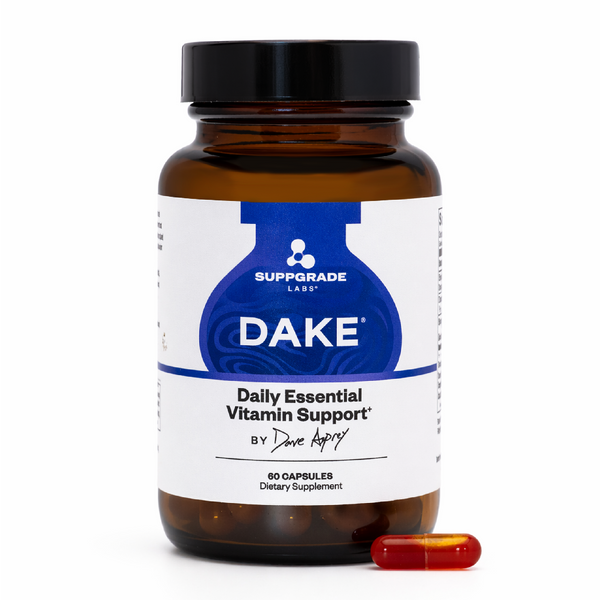
DAKE is a fat-soluble vitamin formula containing Vitamins D, A, K, and tocotrienols, the most potent form of Vitamin E. The formula is designed specifically around the fat-soluble vitamin balance problem: providing all four in a formulation built for absorption and synergy, so they can work together the way the body is designed to use them.
Vitamin D (as cholecalciferol, D3)
Cholecalciferol is the same form of Vitamin D the skin produces from sun exposure. DAKE provides 5,000 IU per serving, supporting bone formation, immune system regulation, and inflammation control.
Vitamin A (as retinyl palmitate)
A preformed, readily usable form of Vitamin A that supports healthy skin maintenance, immune function, and the shared receptor pathways it occupies alongside Vitamin D.
Vitamin K (K1 phytonadione and K2 menaquinone-4)
A dual-form Vitamin K supply. K1 for general cardiovascular support and calcium processing. K2 for directing calcium to bones rather than soft tissues. The combination addresses what high-dose Vitamin D supplementation alone does not.
Tocotrienols (delta and gamma, DeltaGold)
The most potent antioxidant form of Vitamin E, providing cellular protection against the oxidative damage that summer UV exposure accelerates.
DAKE also uses quillaja extract and a patented form of geranylgeraniol (GG-Gold) to support fat-soluble vitamin absorption and delivery, addressing one of the other common reasons supplemental Vitamin D fails to move the needle: poor bioavailability.
The practical answer
The sun is a variable, unreliable source of Vitamin D that most people in temperate climates cannot depend on year-round, and in summer it is offset by sunscreen use, indoor schedules, skin pigmentation, and the basic mechanics of UVB at most latitudes.
The reliable answer is supplementation. Specifically, fat-soluble vitamins in balance. Vitamin D paired with the A and K it needs to actually function, in forms the body can absorb and use.
Get tested. Know your baseline. Supplement with precision.
|
MEDICAL DISCLAIMER The information in this post is for educational purposes only and is based on peer-reviewed scientific literature. It is not intended as medical advice and should not replace consultation with a qualified healthcare provider. Individual vitamin D needs vary. Suppgrade Labs recommends testing your serum 25(OH)D levels before starting any supplementation regimen. |
Frequently Asked Questions
Can you get enough vitamin D from the sun?
For many people, the answer is no. Adequate sun-based Vitamin D synthesis depends on latitude, season, time of day, skin tone, age, sunscreen use, and clothing coverage. People living above 40 degrees latitude face months each year where UVB intensity is too low for meaningful synthesis regardless of time spent outside. A 2024 global analysis confirmed this pattern. (Kift & Webb, Nutrients, 2024)
Does sunscreen block vitamin D?
Yes. SPF 50+ sunscreen reduces Vitamin D production in the skin by 75 to 92 percent. The Sun-D Trial, a 2025 randomized controlled trial in Australia, found that routine sunscreen users ended the year with Vitamin D levels that rose by only 1.6 nmol/L on average, compared to 6.8 nmol/L in the control group. 45.7 percent of routine sunscreen users were deficient by the study's end. The study authors concluded that regular sunscreen users may need Vitamin D supplementation. (Tran et al., Br J Dermatol, 2025)
Should I stop wearing sunscreen to get more vitamin D?
No. The evidence-based approach is to keep wearing sunscreen and supplement Vitamin D separately. Adequate Vitamin D levels are associated with protection against melanoma development, but avoiding sunscreen increases skin cancer risk. There is no need to choose between the two. (Raymond-Lezman & Riskin, Cureus, 2023)
Why am I vitamin D deficient if I spend time outside?
Several factors commonly stack together to prevent adequate Vitamin D synthesis even in people who spend time outdoors: latitude, time of day, sunscreen use, indoor work schedules, glass and windows filtering UVB, skin pigmentation, and age all reduce how much UVB actually reaches skin cells. Vitamin D deficiency has been documented extensively even in sunny climates. (Holick, Am J Clin Nutr, 2004)
How common is vitamin D deficiency?
Researchers have described Vitamin D deficiency as an unrecognized epidemic. It is widespread even in sun-rich countries. People with darker skin, those who work indoors, those who use sunscreen regularly, older adults, and anyone living above 35 to 40 degrees latitude are all at elevated risk. Deficiency has been linked to cardiovascular risk, immune function concerns, and bone health outcomes.
Why do you need vitamin K with vitamin D?
Vitamin D supports calcium absorption, but Vitamin K is required to direct that calcium to the right places in the body, primarily bones and teeth, rather than accumulating in soft tissues and arteries. Supplementing Vitamin D without adequate Vitamin K can potentially lead to calcium dysregulation. DAKE provides both in a single formula.
How does DAKE support vitamin D absorption?
DAKE provides Vitamin D3 (cholecalciferol) at 5,000 IU alongside Vitamins A, K (both K1 and K2), and tocotrienols, suspended in MCT oil for maximum absorption. The combination addresses both the deficiency problem and the balance problem that high-dose D supplementation in isolation does not. The formula also uses quillaja extract and geranylgeraniol (GG-Gold) to further support fat-soluble vitamin absorption and delivery.
|
⚠ Medical Disclaimer The information on this page is for educational purposes only and is based on peer-reviewed scientific literature. It is not intended as medical advice and should not replace consultation with a qualified healthcare provider. Individual vitamin D needs vary. We recommend testing your serum 25(OH)D levels before starting any supplementation regimen. |
Full Source List
[1] Kift R, Webb AR. Estimated benefit of increased sun exposure on vitamin D status in the UK and other temperate climates. Nutrients. 2024;16(10):1489. doi.org/10.3390/nu16101489
[2] Holick MF. Sunlight and vitamin D for bone health and prevention of autoimmune diseases, cancers, and cardiovascular disease. Am J Clin Nutr. 2004;80(6 Suppl):1678S-1688S. doi.org/10.1093/ajcn/80.6.1678S
[3] Raymond-Lezman JR, Riskin SI. Benefits and risks of sun exposure to maintain adequate vitamin D levels. Cureus. 2023. doi.org/10.7759/cureus.38578
[4] Libon F, et al. Sunscreens block cutaneous vitamin D production with only a minimal effect on circulating 25-hydroxyvitamin D. Arch Osteoporos. 2017;12(1):66. doi.org/10.1007/s11657-017-0361-0
[5] Tran B, et al. Effect of daily sunscreen application on serum 25-hydroxyvitamin D levels: the Sun-D randomised controlled trial. Br J Dermatol. 2025. doi.org/10.1093/bjd/ljaf310
[6] Cranney A, et al. Effectiveness and safety of vitamin D in relation to bone health. Evid Rep Technol Assess. 2007. pubmed.ncbi.nlm.nih.gov/18088161
[7] Farrerons J, et al. Clinically prescribed sunscreen (SPF 15) does not decrease serum vitamin D concentration sufficiently either to induce changes in parathyroid function or in metabolic markers. Br J Dermatol. 1998. doi.org/10.1046/j.1365-2133.1998.02405.x